
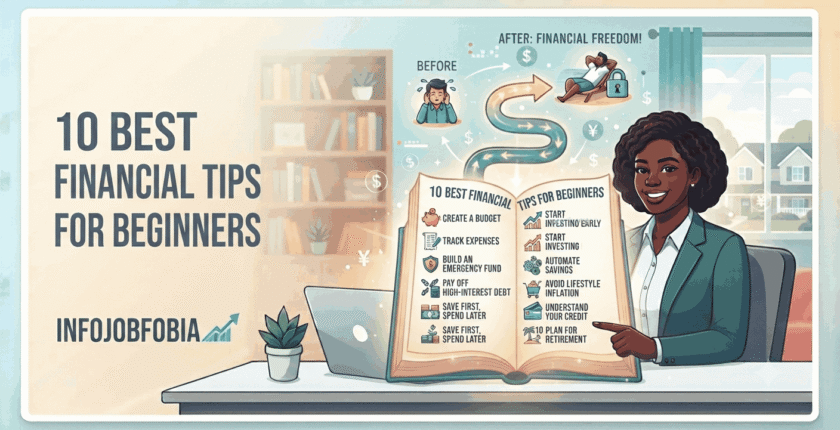
10 Best Financial Tips for Beginners
Nobody gives you an adult handbook. You graduate, get your first job, begin making money, and then out of nowhere you’re expected to know how to budget, save, invest, and prepare for a future you can hardly see. You are far from alone if money management has ever made you feel overloaded. Most individuals learn personal finance by trial and error; they frequently make costly mistakes in the process.
Financial literacy, thankfully, is not about being a math whiz or a Wall Street guru. The goal is to develop a few early, regular behaviors so that your money serves you rather than opposing you. Here are the top ten financial recommendations every newbie needs to know, regardless of whether you just started your first job or you are ultimately ready to get serious about your money.
Keep Tabs on Each Dollar You Use.
What you don’t evaluate cannot be handled. Just knowing where your money goes is the most effective first step in personal finance. Most consumers are startled to realize how much they spend on little, forgettable items, including coffee runs, subscription services, and meal delivery costs.

Begin by monitoring your spending for at least one full month. A basic spreadsheet, a notebook, or budgeting software that automatically sorts your transactions can all help you. The aim is not to judge yourself for every buy; rather, it is to obtain an honest, unambiguous picture of your patterns so that you may make wise decisions moving ahead.
Make a Budget that Really Fits Your Life.
Once you know where your money is going, the following stage is making a budget you will really adhere to. Strict budgets cutting everything pleasant hardly ever last more than a few weeks. Rather, consider using a structure such the 50/30/20 rule:
- 50% of income → needs (rent, groceries, utilities, transportation)
- 30% of income → desires (hobbies, eating out, entertainment)
- 20% of income → debt payback and savings

This is not a fixed rule; change the percentages according to your income and cost of living. The aim is to have a strategy that strikes a balance between accountability and a healthy, sustainable life. A budget ought to be a tool for independence rather than a punishment.
Make an Emergency Fund First
Before you consider making significant purchases or investments, give creating an emergency fund top priority — a cash reserve exclusively for unforeseen costs such as medical bills, vehicle repairs, or an unexpected employment loss.

One frequent aim is to accumulate three to six months’ worth of necessary living costs. Start little if that seems far off right now: aim for a beginning reserve of a few hundred dollars, then develop from there. Put this money in a separate, readily accessible savings account; don’t invest it or use it for anything other than real crises. Having this safety net is what enables you to take daring career or life decisions afterward without money fear influencing your decisions.
Learn the Difference Between Bad Debt and Good Debt
Debt comes in many forms, and knowing this difference will affect your financial choices for years.
- Good debt usually increases long-term value, like a mortgage on a house that appreciates over time or student loans for a degree that raises your earning potential.
- Usually, bad debt supports lifestyle expenditures or depreciating assets. High-interest credit card balances, buy-now-pay-later purchases on non-essentials, or loans for quickly depreciating goods often finance depreciating assets or lifestyle expenditures.
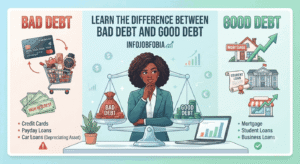
The most important habit for beginners is to stay away from loans with high-interest rates whenever they can. If they already have some, they should make paying them off quickly their top priority. Credit card interest rates can go well above 20%, therefore carrying a balance covertly depletes funds you could otherwise be investing or saving.
Pay Yourself First
Paying yourself first is among the easiest but most life-changing financial practices. This implies that a piece of your pay is deposited straight into savings or investments before you pay bills, before discretionary spending, before everything else.

If at all feasible, automate this procedure. Arrange for an automatic transfer to a savings or investment account to take place on the same day that your paycheck arrives. Automatic saving takes away the urge to spend first and then put away whatever is left, which for most people ends up being very little.
Start Investing Early, Even With Little Amounts
Many newcomers believe investing calls for sophisticated financial expertise or a sizable quantity of money. The most crucial aspect of investing is not how much you begin with; rather, it is how early you start, due to the influence of compound growth.

Over decades, even little, regular deposits into a retirement fund or a low-cost index fund might increase dramatically. You need not time the market precisely or choose certain companies. For most newbies, low-fee diversified index funds provide a simpler, less dangerous starting point than following trends or individual company shares. The earlier you start, even with small sums, the more time your money has to grow.
Learn Your Paycheck and Perks
Many newbies check their paychecks, note the total amount, and go on, unaware of taxes, deductions, or workplace benefits they might be neglecting. Take time to comprehend:
- What is the tax deduction amount and why?
- Find out if your company offers retirement matching, and if they do, make sure to put in at least enough to get the full match. This is basically free money.
- Health insurance choices and their impact on your net pay
- Additional perks include tuition reimbursement, wellness allowances, or stock options

Knowing your entire remuneration package, not only your pay, enables you to make wiser financial decisions and bargain more effectively for future positions.
Resist Lifestyle Inflation.
It’s enticing to match your lifestyle upgrade rate to your income expansion: a better apartment, a new automobile, more expensive memberships. Despite their increasing earnings over time, this tendency, referred to as lifestyle inflation, silently stops many individuals from accumulating actual prosperity.
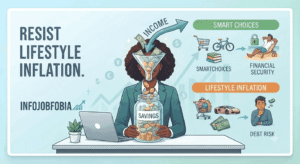
Rather than income growth alone, strive to raise your investment and savings rate in conjunction with your income growth. Here’s a straightforward guideline: before changing your lifestyle, set aside or invest at least half of the increase anytime you receive one. This approach increases your financial stability in line with your achievement, not just your spending patterns.
Get the Proper Insurance to Safeguard Yourself
When you are young and in good condition, insurance frequently seems like an unneeded cost until it is not. Health insurance, renters or vehicle insurance, and finally life or disability insurance all shield you from financial disasters that may otherwise deplete years of savings in a single event.

As a new player, you don’t need every sort of coverage straight away, but knowing what safeguards you have and where the gaps are is a vital component of a strong financial basis. One uninsured accident or medical emergency might wipe out years or months of diligent saving.
Continue Your Education: Financial Literacy is a Skill that Lasts a Lifetime.
Personal finance is not a topic one learns once and forgets. Tax laws change, investing possibilities grow, and your own financial objectives change with your life. Make it a regular practice to learn, whether through books, reliable financial podcasts, courses that are easy to use, or just following honest personal finance creators online.

Whether you’re negotiating a salary, picking a mortgage, or planning retirement decades down the road, the more financially savvy you are, the more assured and powerful your decisions will be.
At Last
Financial certainty results from little, regular behaviors developed over time rather than from one significant choice. Track your spending, create a budget, safeguard yourself with an emergency fund, stay away from high-interest debt, and begin investing early, even if it’s a small sum.

You need not have everything sorted out now. You only need to begin where you are, use one tip at once, and let consistency handle the heavy work. Every financially successful person you admire began precisely where you are now; the only difference is they began.