
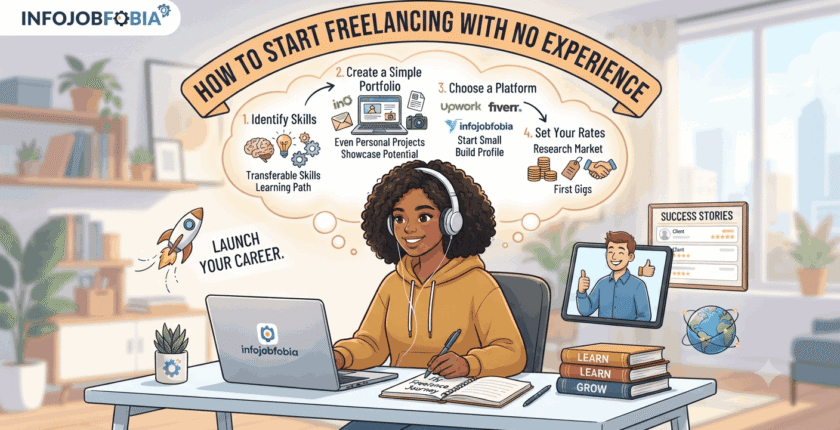
How to Start Freelancing With No Experience
To be recruited, you need experience; yet, to acquire experience, you need to be employed. The classic catch-22, which prevents so many others from ever launching a freelance business, is this: Here’s the truth: if you’ve been delaying freelancing because you believe you have nothing to provide yet, practically every successful freelancer started exactly where you are right now, with no clients, no testimonials, and a lot of uncertainty.
The disparity between those who eventually develop successful freelance careers and those who never begin is not experience. It’s a will to start little, develop evidence of ability, and pick up knowledge as they progress. This is a realistic, step-by-step tutorial for beginning freelancing from scratch.
Find a Skill You May Sell Now
Starting freelancing does not require a rare, extremely niche talent. You require one ability that addresses a particular issue for another person, and most likely you already possess a few prospects without even realizing it.
Think about the following:
- Which friends, classmates, or coworkers have requested your assistance?
- What tasks do you finish swiftly and effortlessly that others find challenging?
- What has genuine worth from your previous employment, interests, or education?

Writing, graphic design, social media management, data entry, virtual assistance, video editing, basic web design, translation, and customer support are among the common beginner-friendly freelance skills. You don’t have to be the finest in the world at your selected ability; you simply need to be good enough to provide actual value to a clientele at the beginning level and develop from there.
Use Practice Projects to bridge the Experience Void.
Make your own paid client work since you still lack any. This is among the most neglected tactics for getting into freelancing.
- Rewrite or redesign something that already exists. Write the About Us page of a company as a writing example. As a design example, reconstruct a leaflet for a local business that was not well-designed.
- Offer free or significantly reduced work to two to three people in return for an honest review and authorization to highlight the work.
- Make fake assignments that replicate real client work, even if there isn’t a real client—a sample social media content calendar, a mock website homepage, a sample email newsletter.

Income is not the aim of this phase; rather, it is creating a modest, reputable body of work you can highlight while seeking actual jobs. Clients who hire newbies simply want evidence you can really do what you say; they are not expecting a twenty-project portfolio.
Create a Simple Portfolio
Though it helps in the long run, you do not immediately need a beautiful personal website. Simple start:
- A free portfolio website leveraging tools like Carrd, Notion, or Canva
- A well-arranged Google Drive or PDF containing your finest sample work
- A sophisticated LinkedIn profile that highlights experience and abilities.

Keep it accurate and clear. Three to five excellent examples are much more convincing than ten poor ones. Briefly describe the project’s objective for each sample and the outcome or talent it shows; context makes your work much more convincing to a quick reader.
Pick the Proper Beginning Platforms.
Some sites make it simpler to get your first few jobs as a newbie with no evaluations or ratings than others.
- Fiverr is fantastic for newbies since customers come to you depending on your service listings (gigs) rather than you having to fight head-on with seasoned freelancers in a bidding war.
- Although Upwork has a steeper learning curve for novices, once you have developed a track record, it offers access to longer-term, higher-paying clients.
- Often disregarded, Local Facebook groups and community boards provide small firms in your neighborhood with much-needed assistance and more leniency for little experience.
- Talking about your new freelance services to friends, family, and past classmates can result in unexpectedly quick initial reservations.

Rather than trying to be everywhere at once, choose one or two outlets to concentrate on at first. In the early phases, depth of work counts more than breadth.
Make Smart Pricing Decisions (rather than simply going cheap).
Many newcomers believe that the only approach to win customers is to pay practically nothing. Although somewhat reduced introductory pricing might help you get your first few jobs, pricing yourself too low can have the opposite effect: it can draw clients who don’t respect your work and impede future rate hikes.

Rather:
- Find out what people who are new to your area usually charge on the platform you chose.
- Price somewhat below average starting out, not significantly below.
- To prevent scope creep, plainly state what your service covers.
- Intend to increase your pricing as you develop confidence and testimonials progressively.
Keep in mind that your initial clients are stepping stones, not a barometer for your long-term pricing.
Write a Proposal that will Really be Read.
Using generic copy-paste ideas seldom works when applying for jobs. Clients can identify them right away. Rather, organize your suggestions as follows:
- Start with relevance; reference something particular from their job post to let them know you really read it.
- In short, explain how you might assist, concentrating on their problem instead of merely your abilities.
- Add one or two pertinent samples, even if they come from practice assignments.
- End with a simple, relaxed call to action, asking for a quick chat or question.

Maintain concise ideas. Clients who are busy skim. Every time, a well-written, pertinent proposal beats a lengthy one.
Deliver Outstanding Work – Every Time
Your initial projects carry far greater significance than their financial returns suggest. Early customer satisfaction can result in:
- a good testimonial you may include in upcoming suggestions
- Repeat business
- Referrals to several possible customers

See every early effort as a chance to develop your reputation, even little or low-paying ones. Be clear, meet deadlines, and go a little above and beyond where you can. In freelancing, reputation grows fast; a few great early evaluations might reveal chances that never would from cold applications.
Expect a Slow Start — and Keep Going.
Almost no one gets their first customer on day one, and that’s okay; it’s not an indicator of failure. Many freelancers submit applications to dozens of jobs before securing their initial booking. The beginners that succeed are not the most inherently gifted; they are the ones who kept perfecting their pitch, kept applying, and saw early rejection as data instead of a judgment on their worth.

Set reasonable expectations: your first month could bring minimum to no revenue. Consider this period an investment in developing skills, evidence of work, and a repeatable process; the income will increase as your reputation rises.
Last Thoughts
Beginning freelancing with no experience is not about waiting until you feel ready since that sensation seldom comes naturally. It’s about finding a skill that you can sell, making your own proof of work, picking the right place to sell it, and showing up all the time, even if it takes a while to see results at first.

Every seasoned freelancer you respect formerly submitted their first proposal with no reviews and an insecure confidence level. The only true need to get started is an eagerness to start less than perfectly and to keep improving with each project that comes your way.