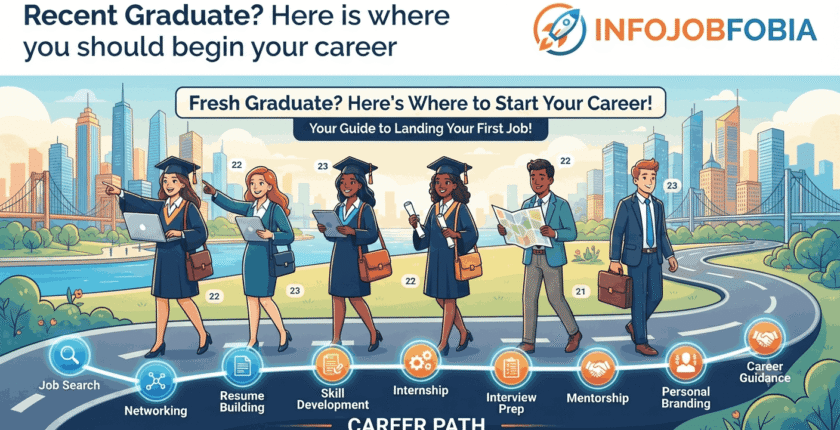
Recent Graduate? Here’s where you should begin your career
Graduation day feels like the finishing line. Years of research, all-nighters, and degree-seeking have gone by; now you have it in your hand and are prepared to conquer the globe. But then reality strikes: what comes next?
You’re not the only one staring at your inbox attempting to figure out where to start. Almost every new graduate encounters the same barrier of uncertainty: too many choices, insufficient guidance, and a terrible anxiety of making the incorrect first step. The good news? Your first work need not be flawless. It simply has to be a wise, intentional first move. This is exactly where you should begin.
Be Specific About Your Real Desires
Pause and ask yourself a few honest questions before you even touch your resume or start browsing job boards:
- Which topics or assignments really piqued your interest throughout your degree?
- Are you receptive to exploring, or would you want to labor in a certain field?
- Do you want stability, quick growth, creative freedom, or a lot of money?
- Do you like fast-paced startups or organized business settings?

A five-year strategy is not necessary for you. You simply require a course for the next twelve to eighteen months. Being clear here keeps you from applying to hundreds of random jobs and instead enables you to aim at positions that really fit your talents and passions. It’s not a personal failure that you’re not sure what to do with your life. It’s a normal part of going from a structured education to a career path that is not clearly defined. Give yourself permission to explore, but do so with purpose rather than panic.
Check Your Competencies (Not Just Your Degree)
In concept, your degree got you in the door; nevertheless, companies recruit for abilities, not certifications. Make a list of:
Technical abilities include data analysis, design platforms, coding languages, software, tools, and so on.
Transferable skills comprise communication, leadership, project management, and problem-solving
Soft skills include teamwork, flexibility, time management, and adaptability.
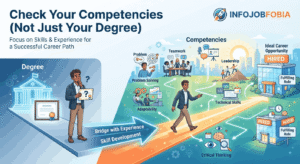
Many recent graduates do not appreciate what they already own. Remember that group project where you had to manage five people and a tight deadline? That is experience in managing projects. That part-time work where you managed client complaints? That is communication and conflict resolution under strain. Reframe your experiences, whether they are internships, volunteer work, part-time employment, or class assignments, as evidence of your employable abilities rather than simply academic checkboxes.
This is also the time to close gaps if you notice any. Coursera, LinkedIn Learning, Google Career Certificates, and YouTube lessons are examples of free and low-cost tools that can enable you to acquire in-demand abilities like Excel, basic data analysis, digital marketing, or coding basics in a matter of weeks.
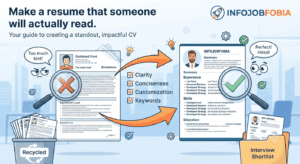
Make a resume that someone will actually read.
On average, recruiters spend 6 to 10 seconds scanning a resume before making a decision on whether to continue reading. As a fresh graduate, your resume needs to work harder because you likely don’t have years of experience to lean on. Here is how to make it count:
Start with a concise summary of two to three lines that emphasizes your degree, main abilities, and the kind of position you’re aiming for.
Count whatever you can. A managed social media page is feeble. A continuous content approach that increased social media interaction by 40% over three months is remarkable.
Give relevance top priority above chronology; place your most job-relevant experience at the top even if it was not your most recent.
Limit it to one page; if you don’t have a lot of experience, one neatly arranged, well-organized page is great.
Change it to fit each use case. A resume that is sent to ten firms and is tailored to each one does better than one that is sent to fifty firms and is not tailored.
Combine this with a straightforward, professional LinkedIn profile. Many employers look at LinkedIn even for entry-level jobs, so an out-of-date or vacant profile might silently reduce your chances.
Never Underestimate Internships and Entry-Level Positions.
There is an enticing trap that new graduates succumb to: waiting for the ideal job with a fantastic title and high pay straight out of the gate. Your first job is actually a springboard, not a life sentence.
Entry-level employment, graduate trainee programs, and even paid internships usually offer:
- Organized coaching and mentoring
- Learning how actual businesses work
- Colleagues and supervisors who can vouch for you later
- A better understanding of what you do and do not desire long-term
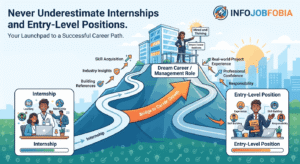
Many successful people developed toward their ideal title rather than obtaining it on day one. Often, it’s wiser to accept a job slightly below your perfect level now, particularly in a business with development possibilities, than to remain jobless for months hunting for an unattainable first work.
Make Use of Your Network Even If It Feels Limited
You might believe you lack a network right now, but you do: professors, classmates, internship supervisors, family friends, alumni from your college, even people you’ve met online.
Networking as a new graduate is more about building genuine relationships and staying visible than about asking strangers for employment.

How to begin in real life?
- Get in touch with graduates of your university who are working in your field of interest; ask for a short informational conversation rather than a job.
- Go to career fairs, seminars, or industry meetings, including those conducted online.
- Interact on LinkedIn genuinely; comment on postings, share your work, and follow companies you admire.
- Ask internship managers or professors if they know of anybody hiring or if they would be willing to introduce you.
Referrals fill an astounding majority of entry-level openings instead of job advertisements. Early networking greatly improves your visibility to hiring managers.
Employ Strategy, Not Fear.
Sending out 200 identical applications every week frequently causes weariness and bad results. Rather:
- Decide on a sensible weekly goal (e.g., 10-15 well-tailored applications).
- Simple spreadsheet tracking of applications: job, company, application date, status, follow-up date.
- If you have not heard back after one to two weeks, follow up softly.
- Prepare for interviews by studying the firm, going over frequently asked questions, and planning a few insightful questions of your own.
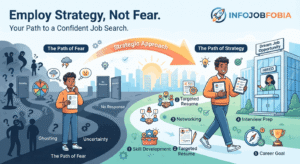
Regularity and quality trump volume. A custom application with a somewhat changed cover letter is almost always better than a mass-blasted one.
Handle the employment-sensitive side of job-seeking.
Let’s bring up something that isn’t often talked about openly: searching for employment after graduation can be emotionally taxing. Rejection emails, prolonged quiet, and comparing yourself to peers who found employment more quickly can all chip away at your confidence.
Several elements help:
- Set limits on how much time you spend looking for a job every day to avoid getting burned out.
- Celebrate small wins, including an interview, a positive answer, or a freshly learned skill.
- Most careers aren’t linear; hence, a slower start doesn’t define your future.
- Rather than trying to manage the pressure on your own, get help from friends, relatives, or mentors.
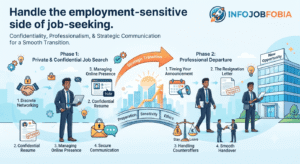
The search for your first employment is a skill in itself. The more you do it and the more patient you are, the better you get at it.
Finally
Starting your career after graduation does not require knowing everything. It involves taking the following suitable actions: defining your career path, honestly assessing your abilities, creating materials that show your true worth, being open to entry-level jobs, and deliberately using your network.
From graduation to a significant job, there is no one proper path; rather, there is the one you build one purposeful decision at a time. Start where you are, employ what you have, and trust that with every interview, discussion, and application you take along the path, momentum grows.
The day you land your dream job is not the beginning of your career. It all starts today with the first decision you make.