Job Search Anxiety: Why Applying Is Impossible
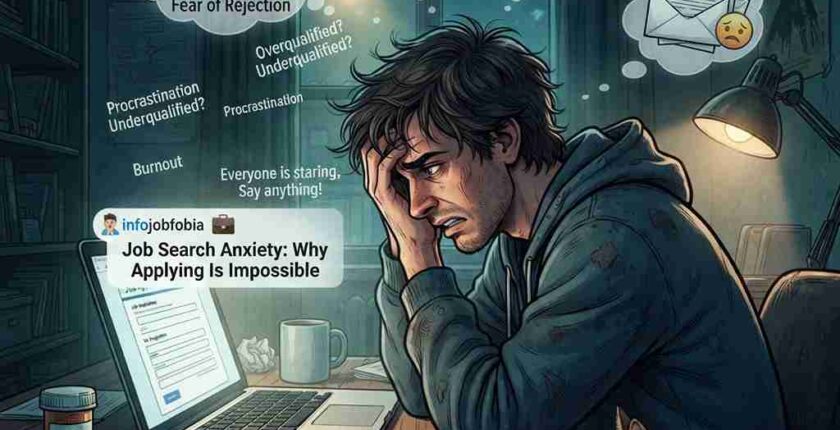
Once, I had 11 job posts open in browser tabs for four days straight. I didn’t apply to any of them.
Once, on the afternoon of day four, I opened my laptop and clicked on some tab. I looked through a job description and closed it. Day after day, I would open another tab, read and close it. And in the end, I had not sent a single application that week, but I had “looked for a job” for six hours.
If you are nodding along right now, you know it’s not about being lazy. Everyone around you — parents, friends, that one LinkedIn post saying “Just apply to 5 jobs a day!!” — perceives applying for a job as a mechanical task. You need to open the form, fill in all the boxes, press the button, and it’s done. If it were that simple, you wouldn’t be reading an article about why it seems so complicated.
It’s not a motivation issue; it’s an anxiety issue disguised in a motivation costume.
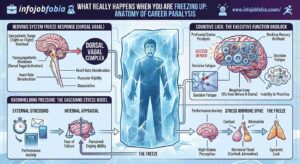
What really happens when you are freezing up
The key is that nobody says that a job application consists of fifteen tiny tasks, and every single one of them implies some sort of risk related to your judgment.
The process of tailoring your CV means deciding which version of your work experience is “good enough” to be presented to an unfamiliar person. The task of writing a cover letter lies in your attempt to figure out what a company wants to hear from you and the assumption that you will guess it correctly. Finally, clicking the submit button means opening yourself up to the danger of not hearing anything at all, or, even worse, receiving a rejection email which will appear in your inbox alongside a Deliveroo delivery notification as if nothing happened.
Your brain treats the uncertainties mentioned above in the same way as an actual threat. That’s not a matter of your exaggerated reaction – that’s the way the threat-detection system works. It cannot differentiate between “job rejection” and “actual emergency”. It understands only that something is uncertain and something can go wrong. So, it applies the brakes.
And you also probably understand those people who have so many tabs open that you can’t even count them, or those people who say “I will do it after lunch” and never do it. But I have to admit that I am one of those people who can spend hours reorganising the formatting of their CV for no apparent reason at all. It’s quite fun, and it feels like progress, and it also doesn’t require me to risk getting rejected.
This is not a character flaw. It’s avoidance, which is what anxiety is built to cause.
The pattern that I hadn’t noticed till someone told me about it
My friend, who had a difficult redundancy the year before me, said something that remained forever in my memory: “You are not avoiding writing the applications. You are avoiding learning the answers”.
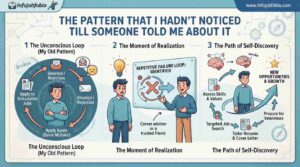
This was an amazing realisation. I was afraid not of applying, but of what might happen when I applied, namely, of the possibility that I am not employable enough and the career gap in my CV matters.
My not applying kept the feeling theoretical. As long as I hadn’t applied to anything, I could say to myself: “I’d get it if I tried”. The moment I applied, and nothing happened, that comforting story had vanished.
One should point out that it is one of the most frequent pitfalls and the reason behind the prevalence of unhelpful advice. Telling a person to “apply to more jobs” is the same as saying to a person who suffers from the fear of flying to “just fly.” Technically, this advice is true but utterly useless since it does not deal with the psychological problem.
Signs it’s anxiety and not just procrastination
A few things that I noticed in myself and afterwards recognised in others experiencing the same thing:
- You research a job posting intensely – company, team, Glassdoor reviews, hiring manager’s LinkedIn profile – but this research never leads to submitting a job application.
- You know that you feel differently when you are filling out the application for a new job. You feel some anxiety, you breathe shallowly, there is a weight on you that makes it hard to even open the laptop.
- You’ve rewritten your cover letter introduction six times, and it’s still incomplete.
- You catastrophize one small thing — a typo or awkward sentence into “they’re definitely going to reject me for this.”
- It is a feeling of relief, not disappointment, to talk yourself out of something. And this feeling is the indicator – your nervous system just got what it wanted – to avoid the threat.
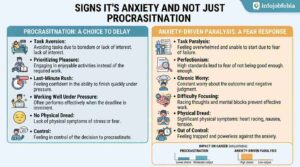
If any part of this sounds familiar to you, you are not dealing with a problem with discipline but rather with your nervous system, which has determined that job applications are dangerous and is going to keep steering you away from them until the conditions change.
What actually helped me get unstuck
I want to start with honesty: this method did not make my anxiety disappear. Even now, in a job where I have worked for over a year, I sometimes feel anxious. The difference is that I do not require my anxiety to disappear before I can act. This distinction is the most important aspect of this article.
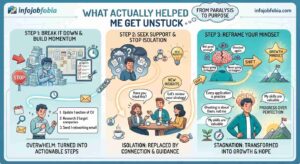
1. I stopped applying to the “whole job” and started to apply to the sentence.
For example, instead of sitting down with the goal to finish the application, I would set myself a goal to write one sentence of the cover letter. Only one sentence.
It might seem insignificant, but it works because your brain is not facing the requirement to “write a sentence.” Instead, it is meeting the challenge of “completing the enormous and risky task.” Shrinking the task helps to reduce the level of the threat.
Usually, having written one sentence, I kept going since the main thing was to start, not continue. However, even if I stopped after one sentence, it was still progress, a completely different thing from the blank page with closed tabs.
2. And then I constructed a template, which is called a “cold” template, so the decisions are not being made live.
A big part of my freeze comes from making decisions in real time when I already have an activated anxiety — which points of my experience to mention and what phrases I should use to describe myself as someone whose experience matters.
Thus, I created my CV and a basic cover letter on a peaceful day, not when I was stressed about applying for jobs. When I started applying somewhere, I just adjusted a couple of lines in order to make them relevant to a specific role. It was much easier than trying to create everything from scratch in stressful circumstances.
I always had mine saved in a Google Document with several paragraphs that I could swap according to the position I was applying for — leadership experience, tech details, or client-facing examples. Swap, change, and done!
3. I established a threshold for “good enough” and stopped moving it
This was the hardest one for me. I liked perfectionism because it’s a socially acceptable form of procrastination. “I just need to make my cover letter better” will last forever if you want it to.
I had a certain principle: three read-throughs, then sending. Not five. Not “until it felt right” – that feeling doesn’t exist for an anxious brain, no matter how good you are. Three passes, fixing what was clearly wrong, and then sending.
The applications I agonised over for three hours got the same response rate as the ones I sent after twenty minutes. It was a very useful, although slightly deflating, thing to learn.
4. The way I handled rejection was Boring
Yes, it might sound unusual, but you should believe me. First of all, I made up a simple table of information about companies, the position you are applying to, date of submission, and status. Whenever I receive a rejection letter, I just type “rejected” into a cell and move to the next row. No re-reading the e-mail many times. No despair about your mistakes. Just log, close, proceed.
Turning the rejection into another data point instead of a personal verdict has reduced its influence a lot. It is still not fun, but it is very different to say that “it is just another row in the spreadsheet” and “I am not good enough”.
5. I stopped applying at night
Tiny thing, but it had more effect than I expected. The evening was my worst time – tiredness, low energy and no will to fight the anxieties.
Mornings were very helpful for me. I had more brainpower in the morning, and if I felt any unpleasant emotions during the day, I could distract myself and forget about them due to the fact that I had a whole day ahead of me.
Step-by-step explanation if you need something to copy
Pick a time box of just 20 minutes. No “today I’ll be hunting jobs” concept. Pick only 20 minutes, once, right now.
Open some job posting you’ve been ignoring before. Don’t pick the scary one – pick the mid-tier posting. Save your dream job for once you’ll have some momentum.
Write one sentence in your cover letter template that should be adjusted to this particular position.
Make sure there are only three edits; otherwise, stop editing.
Hit the submit button before rereading your application. Honestly, close the tab immediately after clicking submit to prevent rereading your application.
You’ll need to track this by company, role, and date. That’s the part many people skip, but it’s really one of the most important ones, because it turns nothing into proof of your work.
Do something completely unrelated afterwards. Walk, watch a film, text your friend. Give your nervous system some kind of proof that applying did not end your world.
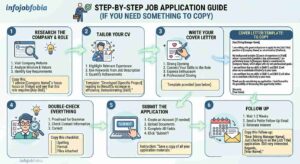
Do this again tomorrow. Don’t be too ambitious, and don’t set a certain number of applications you need to send every day, according to some LinkedIn influencer. Just do the same cycle over and over, and let the number of your applications rise automatically, as a result of this habit.
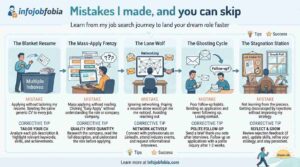
Mistakes I made, and you can skip
Comparing my progress to the success stories of others. Someone writing “got hired in two weeks!” on LinkedIn is not fair to anybody in terms of their industry, location, mental state, and luck. Comparing oneself to a highlight reel adds anxiety to anxiety.
I tried applying to all possible vacant positions. Hoping to get lucky due to the sheer numbers. At that time, I was in a desperate situation and applied for jobs I did not want at all. Later, I understood that my approach was counterproductive because I received many rejections that lowered my morale.
Telling myself that I would “feel ready” eventually. I was waiting for some magical feeling which would never come on its own. Readiness for an anxious job search shows up after you start the job search, but not before it.
Avoiding talking about it instead of communicating my concerns. I did not tell anyone about the freeze-up for months because I was ashamed to confess that opening a construction site caused tightness in my chest. After telling the problem, many people who listened to me shared that they had had similar experiences with job freezes. It means that freeze-up is a very common problem.
Mixing “I feel anxious” with “I’m doing something wrong”. These two were constantly intertwined for me. Being anxious about applying doesn’t mean the application itself is bad or that I’m bad at it. It means that this situation is unpredictable, and unpredictability is unpleasant. Nothing else.
If it’s more than “uncomfortable”
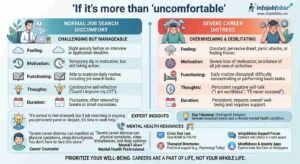
However, you can differ from normal discomfort of job hunting and go into panic attacks before an interview, not being able to eat and sleep for days, worrying constantly about your applications. If that is your case, you can contact your doctor or therapist in order to find out more about the problem instead of trying to cope with it on your own with templates and timeboxes. You won’t win any prize for trying to endure this alone, and asking for help from a professional is a sensible option when you cannot cope with the stress any longer.
Last thought
The applications were not becoming less frightening when they became simpler. It is becoming less scary because I am no longer waiting until I feel courageous to apply for positions and do what needs to be done. And it shows me now that I can tolerate some level of discomfort in this and do the little things that I want to do.
If you’re sitting now with eleven open tabs on your screen, you don’t need to close them all and turn yourself into a completely different person tomorrow. You just need one sentence in one tab today. And the rest will follow.