

How Long It Takes to Make $1,000 Online
To this day, I remember the exact moment I looked at my PayPal balance and saw a four-figure sum there for the first time. It wasn’t a lot of money, not enough to quit my job. However, it was $1,000, which was earned thanks to what I made myself at 11 pm in an old three-year-old laptop whose noise at times sounded like taking off a small aircraft each time I opened the sixth tab.
That number I achieved in eight months.
Eight months. Not the kind of make money online quickly that one is being advertised with some guy standing next to the rented Lamborghini on YouTube. Eight real months with trials, errors, deleted projects, and nights when I was going to give up everything and accept that maybe there is no such thing as making money online.
And for those of you who are sitting here, wondering how much time this will take, I understand you perfectly.
So, here’s the honest truth based on my own experience and observing many people I know going through the same road: it depends. But it’s not dependent on vague reasons you’re used to hearing about. There are actual, concrete reasons why some people manage to earn $1,000 in three weeks while others take a year and a half. Let’s dive deeper into it.

The Short Answer Nobody Wants to Hear
If you are starting from scratch – no audience, no skills, no email list, and no connections whatsoever – the realistic period is from 3 to 9 months for most of the people.
Some lucky people can reach $1,000 in just a few weeks if they get good timing or already have some skills from their job.
But if you have been building the software from scratch and learning by doing, then you should plan your work for a season, not a weekend.
I know that this answer is not the one that the advertisements of “make $500 a day” are giving, but it is honest, and I would rather know the truth from the beginning than quit in week three believing that I am already rich.
Why There Is So Much Difference in Timings For Everything
I have already had enough people talking to me in this sphere, through comments, DMs, and even a few actual meetings. I’ve been talking to a variety of people in order to notice a trend in their timelines. I can say that there are 4 factors involved in their case.
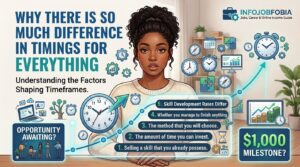
1. Selling a skill that you already possess.
There is my friend Sana, who was a graphic designer in a small agency. She started freelancing using Fiverr and earned her first $1000 within 6 weeks. The reason why she succeeded is that she was not learning design and how to make money online simultaneously. She was just learning how to make money online.
It differs a lot from my own case. I started with content and website building, having no idea about any of these things. I had to study writing, basic SEO, some WordPress features, and audience behavior on the internet in addition to monetizing. Two learning curves make everything much slower.
2. The amount of time you can invest.
This advice may seem obvious, but people underestimate it. I used to do it in my free time during evenings and weekends when I was working full-time for the first 4 months. The number of hours I spent on my side business was about 8-10 hours a week. Someone who spends 25-30 hours a week will move three times faster than me.
3. The method that you will choose.
As you can see, some of the described methods are faster than others. Freelancing is probably the fastest option since it is based on immediate exchange of money for time – there is no need to build an audience or make efforts to get traffic. In contrast, blogging, affiliate marketing, and YouTube are much slower since it will take time to attract an audience to your blog or channel and then earn money from it, regardless of the quality of your content.
4. Whether you manage to finish anything.
It hurts, but this point is the real dealbreaker. Before I finally found what works for me, I had three false starts. One Shopify store that I left after five weeks. One YouTube channel with eleven videos and forty subscribers. One blog on productivity that was alive for two months and then I forgot about it. Each restart resets your clock. If you switch ideas every six weeks, you will never let your idea work.
What My Eight Months Really Looked Like
Let me show you a timeline of events instead of just telling you that there is one. Here is roughly what happened during the process of developing the AI assistant.
Month 1: Research and failure. My first attempt was Dropshipping, which lasted two weeks. It was inspired by those videos where people make $10k in a weekend. I spent $150 on Facebook ads and made only one sale, which I cancelled after two days. Lesson learned: If the method involves spending money before you know what to do, you’ll likely lose your investment.
2 months later, I started freelancing as a writer on Upwork. I sent about 60 job applications. I received two replies and landed one $40 gig for writing a blog post. It was very little, but it showed me that I can earn money with the help of the idea.
Months 3-4: Slow, steady freelancing work, bringing in $150-200 per month. Although it wasn’t particularly lucrative, it was a steady source of income. Simultaneously, I decided to create my personal portfolio website – it was done absolutely accidentally but turned out to be the thing that made money later.
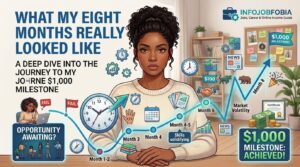
Month 5: I started applying the content I created for my clients to my own website. SEO, a couple of posts per week, nothing special. Traffic was very low.
Month 6:Traffic was growing. Google AdSense approved my application. This month, my income was $11.47. I laughed at how low it was, but I was really happy about it because this was money that I earned while I was sleeping.
The seventh month gave me income from freelance writing, advertising, and affiliate sales – $600+ for the whole month.
Month 8: Through my freelance projects, ad revenue, and two affiliate commissions, I earned over $1,000 for the first time in a month.
Freelancing was what saved me in the first months and kept me going. The website became something I worked on continuously, and it paid off in the future. Neither of them would have brought me anywhere as far as the income is concerned.
How to Speed Things Up: Step-by-Step Method
If I were to start my work again today, knowing all that I know now, this is exactly how I would do it in the beginning.
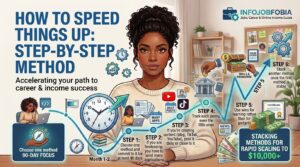
Step 1: Choose one method and commit to it for at least 90 days
Try not to do anything for two weeks and see what happens. You need at least 90 days. Most methods do not give real results until month two or three. Quitting after week three is the single most common reason people do not make any money online.
Beginner-friendly choices include freelance writing, graphic design (even very simple), virtual assistance, and some basic web development (if one is ready to learn something new).
Step 2: If you are freelancing, you have to send many applications
My mistake was applying to jobs once a week. The people who got jobs quickly were applying to 15-20 gigs a week and used personalized pitches for each. Volume + personalization = breakthrough.
Step 3: If you’re creating content (blog, TikTok, YouTube), post it daily or close to it
Inconsistency in posting is the reason why most content projects die without any notice. I know this since I have been running my own TikTok accounts for a long time. The difference between the weeks when I posted three times per day and when I posted once per day was colossal in terms of growth. Regularity brings results, whereas occasional posting is not effective.
Step 4: Track each penny, even the little ones
I made a silly spreadsheet with two columns: date and amount of money earned. Seeing my $11 turn into $40 and then into $180 kept me from giving up during those boring months.
Step 5: Use wins for learning rather than for gadgets
I was even tempted to buy a ring light for making content with the first fifty dollars I made, but instead I chose to invest it in an SEO course. This course caused a traffic increase in month 6.
Step 6: Stack another method once the first method is stable
When my freelancing business started bringing me $150-200 per month, I added the website to my existing strategy instead of switching to it. Stacking is better than switching!
Mistakes I Did to Fail and What You Need to Avoid to Succeed
Chasing new make money online trends. Every time a new trend appears in my social media feed, I want to switch to it. First, I was dropshipping, then print-on-demand, after that crypto trading, and finally I was back to freelancing. Every time I changed the way of making money, I lost some weeks on it.
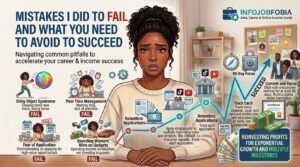
Underpricing freelance work. In the beginning, I wrote for $5-8 per article because I was scared that no one would hire me at a higher price. This situation hampered my income. Around my fourth month of freelancing, I raised prices and, paradoxically, started getting better clients and no fewer ones.
Ignoring my analytics. I did not check Google Analytics or my TikTok analytics up until month 5. After that, I figured out that 2 of my articles bring me 80% of the traffic. If I had doubled that effort two months earlier, I would have.
Month 2 comparison to month 12 from someone. It is more of a mental pitfall than any other mistake that I can mention. I failed to see my own success because I compared it to other people. When I see people making $5k in a month after spending a year of hard work and experience, and I make $40, I get discouraged. However, it is important to realize that I still have much less experience and much less work than they do.
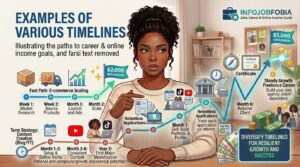
Examples of Various Timelines
As far as the perspective of other people is concerned, I have the following observations:
One guy that I know started tutoring online via Preply and already had a teaching background. The first month when he earned over $1,000 was about 5 weeks after he started teaching.
For example, in one of my freelance Discord communities, a person spent almost a year trying to earn $1,000 (total, not monthly) on print-on-demand. The issue was inconsistent posting and a six-week gap during which she didn’t visit the store at all.
My colleague’s cousin decided to sell digital templates on Etsy. Her first thousand in sales came around the fourth month of selling digital templates. It was achieved through selling many cheap templates ($8-15 each).
Each timeline is correct; it depends on factors such as skill, time, method, and consistency.
So What Should You Actually Expect?
But if you want to have a real-world planning number: prepare 3-4 months of savings for freelancing with existing skills and 6-9 months for building something new, like a blog, YouTube channel, and/or online shop without an audience.
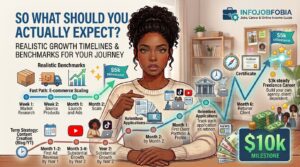
I think that the time frames I’ve mentioned are average, so anyone who offers something faster as a guarantee is probably either extremely lucky, leaving out important facts, or just trying to sell something to you.
And even if in months 4 or 5 your earnings still stay at $80 per month, not $1000 per month, it does not mean that it is not working. It means only that you are at the place you should be, on a much slower pace, but still a normal one.
That $11.47 a month seemed absolutely pointless then, but two months later it was not.