
The Ultimate Guide to the Fulbright Scholarship USA
I will never forget the moment when I almost gave up on my dreams of studying in the US. It was late at night, two o’clock in the morning, and I was sitting at my computer, looking at the tuition fees of the Master’s program at a university in New York. The page showed the tuition fees – $60,000 a year. Sixty thousand dollars. And that wasn’t counting the rent, food, and the tickets to America.
I slammed my laptop shut. I didn’t have an uncle who could sponsor me, and taking out such a huge bank loan felt like financial suicide. I assumed that the American Dream was only meant for rich people.
A few days later, my professor happened to mention the Fulbright Scholarship USA. I had already heard of this scholarship, but I had always assumed that it was designed for extremely talented people who managed to invent an application in their high school and graduated with honors at the age of 22.
But I looked into the scholarship anyway. And I must admit that applying for it entirely changed my life.
If you are an international student and are looking for fully funded scholarships for international students, you’ve probably seen the Fulbright scholarship in many search results. However, official websites dedicated to this scholarship are confusing, dense, and full of bureaucratic language.
So, here’s the ultimate guide based on real experience – the information that you won’t find anywhere else.
What is the Fulbright Scholarship USA?
First things first, I want to break the misconception that Fulbright is just a purely academic scholarship. Yes, it will cover your Master’s or PhD program, but the officials running the program (U.S. Department of State) are not interested in your academic performance only. Their main interest is cultural exchange.
It is one of the most prestigious US government scholarships in the world and is operating in more than 160 countries. The main goal of the Fulbright program is to bring future leaders of different countries to the U.S., to let them experience American culture, share their own culture with Americans, and return to their home countries to make a difference.
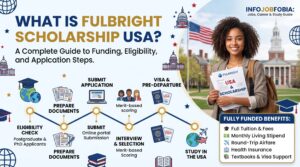
Thus, if you approach your application trying to impress the selection committee with your intellectual potential only, you won’t be successful. On the other hand, if you are going to try to show yourself as a community builder who aims to solve some problem in your home country, you have a high chance of being selected for the scholarship.
The Money: What Does “Fully Funded” mean?
When I say that the Fulbright scholarship is the holy grail among fully funded scholarships for international students, I mean it. Most of the scholarships that are called fully funded actually hide certain costs.

So, what will the Fulbright program cover?
-
University tuition – 100%: It means you don’t even see the tuition bill.
-
Monthly living stipend: The amount of the stipend depends on the place you live.
-
Airfare: Round-trip airfare to the U.S. and back home.
-
Health insurance: This scholarship covers basic health insurance in the U.S. However, the dental and vision expenses are usually excluded.
-
Book and equipment allowance: You’ll get some amount of money to buy books or a new laptop at the beginning of the semester.
-
J-1 Visa sponsorship: This scholarship will cover all expenses and the application process for your visa.
In other words, your only task is to focus on studying, networking, and staying in good academic standing.
Am I Eligible?
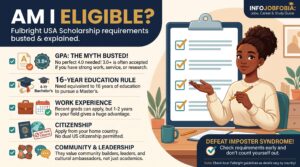
This is the point when imposter syndrome often appears among many candidates who are convinced that they are not smart enough to be considered for such prestigious scholarships. However, the eligibility for the Fulbright scholarship is much broader than you might think.
-
The GPA Myth: You don’t need a perfect 4.0 to be accepted into the Fulbright program. While academic achievements play an important role, many people with a GPA of 3.0 have been accepted into the scholarship due to their strong work experience, community service record, and outstanding research proposal.
-
Work Experience: While it is possible to apply as a recent graduate, having at least one to two years of work experience in your chosen field gives you a significant advantage.
-
16-Year Education Rule: To receive a Master’s degree, one usually needs 16 years of education (4 years for a Bachelor’s).
-
Citizenship: You have to apply from your country of citizenship, and you cannot have dual US citizenship.
Note: Application procedures and deadlines vary depending on the country where the applicant resides. Always check your local Fulbright Commission’s website for exact information.
The Beast of Applications: Step-by-Step
The Fulbright application process is a long and tedious journey from the day you begin the process of applying until the moment you get on the plane. It may take about 14-16 months and demands patience from you.
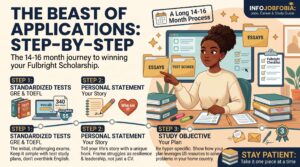
1. GRE and TOEFL (The Standardized Headache)
Depending on your country, you usually have to take the GRE (Graduate Record Examination). This test is painful. The math is basically high school level, but the vocabulary section feels like it was written in the 1800s.
My mistake: I bought huge, expensive GRE preparation books which literally made me fall asleep.
What actually worked:
-
GregMat: This is a website run by a guy named Greg. It costs like $5 a month and is infinitely better than $1000 prep courses. His 1-month and 2-month study plans are legendary.
-
Magoosh: Good app for learning vocabulary. I used to learn 20 new words every day while traveling.
-
For the English Test (TOEFL/IELTS): Do not overthink it. If you are able to watch Netflix without subtitles, you just need to learn the test format. Some weeks of practice are usually enough.
2. Personal Statement (Who are you?)
This is where a large number of people miss their chance. Do not create a resume chronology in your cover letter. Your resume already shows this.
Your personal statement needs to be a story. It needs a hook. Why do you care about your field? What was your “aha!” moment when you understood your path?
Pro tip: Don’t make a sob story just to get pity. If you faced some difficulties, frame them around resilience. How did overcoming this obstacle help you become a leader?
3. The Study Objective (What are you going to do?)
If your Personal Statement is who you are, your Study Objective is what you are going to do and why.
Be very specific. Do not simply state that you are going to study public health because you want to help people.
Instead, write something like:
“I want to pursue a Master’s degree in Public Health focusing on epidemiology in order to learn data modeling techniques used by the CDC, and then apply them in my country to improve our rural infectious diseases tracking systems.”
Do you see the difference? You need to show that you have an idea and the plan to use the US resources to achieve it.
4. Letters of Recommendation
You usually need three letters. Here is a golden rule:
A detailed recommendation letter from an assistant manager who knows your daily work is 100 times better than a generic, two-sentence letter from a university dean or even a CEO who does not recognize your name.
How to ask without annoying people: When you email your recommender, do not just ask, “Can you write a letter for me?“ Instead, help them out: “Hi Professor X, I am applying for the Fulbright scholarship program and would like you to highlight my analytical skills, which I showed in my final project on [Topic].”
Make their job easy, and they will write you a great review.
The Interview Process: Sweaty Palms and Suit Jackets
Once your application has been reviewed, you will be invited to an interview.
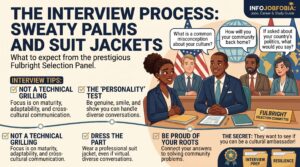
I was terrified of my interview. I memorized dates, facts, and statistics about economics and my industry. I was prepared for a tough technical grilling.
It started when I walked in (virtually or in-person, depending on the year) to find a panel consisting of four people – mostly American diplomats and Fulbright alumni. Instead of technical questions, they asked:
-
“If you are asked about your country’s political situation by an American student, what would you say?”
-
“What is a common misconception Americans have about your culture?”
-
“How will the degree you are planning to study help your community when you return to your country?”
The secret of the interview: It is a personality test! They are looking for maturity and whether you can adapt and hold a decent, respectful conversation. Smiling and being honest will help you a lot.
3 Huge Mistakes That Tank Applications
If you are going to apply, please do not do these things:
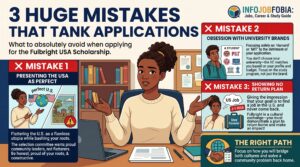
1. Presenting the USA as Perfect
A lot of applicants think they need to flatter the US government. They write essays about how America is the perfect utopia and their home country is terrible. The selection committee hates this. Be proud of your roots. Acknowledge your country’s flaws, but focus on how you want to fix them.
2. Obsession with University Brands
You do not get to choose your university. It’s the Institute of International Education (IIE) that matches you to a university according to your profile and budget. If your essays are only about wanting Harvard or MIT, it looks very arrogant. Focus on the program itself.
3. Ignoring the Effects of One’s Actions
If your essays give the impression that your goal is to find a job in Silicon Valley and never come back to your country, you will be rejected immediately. That brings me to the main “catch” of the entire program…
The Catch: The J-1 Visa “Two-Year Home Rule”
So, I need to address the obvious elephant in the room – the Fulbright is not some type of immigration scheme.
If you get the scholarship, you will travel under a J-1 Exchange Visitor Visa. This visa comes with the Section 212(e) Two-Year Home-Country Physical Presence Requirement.

What does this mean in simple English?
It implies that after graduating from your degree program in the US, you are obliged to return to your home country for a total of two years before being able to apply for non-immigrant visas (like the H-1B) or a Green Card (Permanent Residency).
During those two years back home, you are able to get a visa to visit the USA as a tourist and search for a job in the UK or Canada. However, you will not be able to stay in the US for a long time right away.
Some people find this to be a major hurdle. However, in fact, it shouldn’t be. The network created during Fulbright is global, and having “US Department of State Scholar” on your LinkedIn profile will open many doors in top-tier companies, government agencies, and NGOs in the future.
Wrapping It Up
There will be weekends when your friends are outside having fun while you are at home working on your GRE math test or a personal statement which you have already rewritten nine times.
Push through the discomfort and make it happen.

Most people fail simply because they never push “submit”. They tell themselves that they are not smart enough, not rich enough, or not good enough. Let the admissions committee make their choice. Don’t reject yourself before they can evaluate your name.
Now it’s time to start doing the work. First, begin organizing your documents, then look for a cheap GRE prep site, and finally, start writing your story. What’s the worst they can say? At worst, you’ll hear “no”. However, if they agree, you’ll get a free Master’s degree, a brand new perspective, and an experience that will change your whole life. Good luck! Let me know in the comments if you have any questions!
For more job search, career tips, and study abroad guides, make sure to keep exploring Info Job Fobia.