
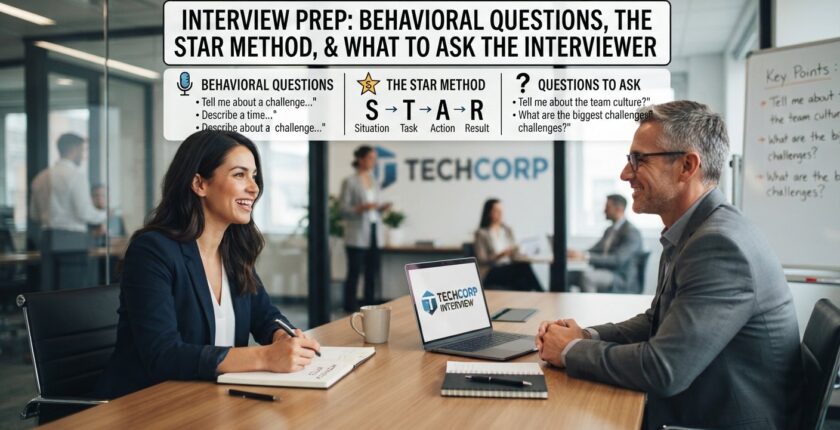
Preparing for an Interview: Behavioral Questions, the STAR Method, and Things to Ask the Interviewer
When an interviewer sits back and asks, Tell me about a time you handled conflict at work, there’s a special type of panic that takes over. Your thoughts go blank, you grab for the first hazy memory that comes to mind, and you wind up rambling through a tale that doesn’t quite land anywhere. If that has happened to you, you are among good company; behavioral interview questions trip up even really qualified candidates, not because they lack excellent stories but rather because they have not practiced telling them effectively.
The good news is that behavioral interviews are among the most ready-to-use components of the whole hiring process. Unlike queries on hypothetical future events, they are asking about things that have already occurred to you. You simply need a system for extracting those stories in a way that truly makes sense under pressure.
Why Businesses Initially Ask Behavioral Questions
A basic premise underlies behavioral interviewing: past behavior projects future behavior more accurately than hypothetical responses do. Anyone may claim hypothetically they would manage a demanding coworker elegantly. Much fewer individuals can provide actual details and a real result of a true event they really did.

That is why you will come across sentences like Tell me about a time when… or Give me an example of… These are simple questions. They’re an invitation to demonstrate, with proof, that you have the skills you’re highlighting on your resume.
The STAR Approach: Your Structure for Not Ranting
Most people left to their own devices either get lost in needless details halfway through or tell a story with no discernible theme; therefore, the STAR approach helps. It provides you a basic framework to apply:
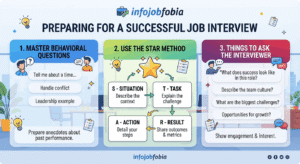
Situation: Start by giving a quick backdrop. What was the background? Keep this section short; it’s background, not the main event.
Task: What was your particular challenge or duty in that case? Here is where you explain what was actually requested of you instead of the team at large.
Your response’s center is action; therefore, it needs most attention. What did you specifically do? Not what we did as a team, but rather what you individually chose, spoke, or carried out. This is the section of the interview interviewers actually want.
Result: Finish with the result, ideally something quantifiable or at least plainly visible. Was the project delivered on schedule? Has the relationship changed? Was there an increase in income? Say also if you gained knowledge from a less-than-perfect outcome; a well-managed disappointment usually yields a more remarkable response than a faultless success narrative.

Most individuals do not misinterpret the STAR framework but rather their attempt to construct stories on the spur. Before any interview, sit down and actually write out four or five stories from your work history that could stretch to cover common themes: a conflict you resolved, a mistake you made and fixed, a time you led without formal authority, a project that didn’t go as planned, a moment you had to persuade someone who disagreed with you. Having these ready helps you to remember a narrative you have already molded, not to create one under duress.
Popular Behavioral Questions Worth Getting Ready For
Though you can’t predict every question, certain themes come up repeatedly in different sectors: explain a conflict with a coworker or manager, tell me about a time you failed, describe a situation when you had to meet a tight deadline, tell me about a time you opposed a choice, explain a time you had to learn something quickly. Usually, if you have good STAR stories for these broad themes, you will be able to modify one to suit whatever form of the inquiry arises.

Remember: You Are Also Under Interviewing
Most interviews end with the part everyone half-forgets to get ready for: Do you have any queries for us? Saying no, I think you covered everything, is a missed opportunity. Thoughtful questions serve two purposes: they help you determine if the position is truly suitable for you, and they show the interviewer your engagement and critical thinking rather than only wishing to get an offer.
Bypass any questions you might readily discover on the company website. Rather, inquire about things that demonstrate actual interest in the team and the job: What does success in this position look like following the first six months? Right now, what is the toughest obstacle for the team? How would you characterize the way the team works? What factors led you to want to start working for this business, and what makes you remain here? Anything about my history cause you concern regarding my suitability for this position?

Though it could feel strange to ask, that last one is quite helpful; it gives you the chance to address any resistance directly rather than leave it unsaid, and interviewers usually appreciate the readiness to ask it.
The Larger Perspective
Preparing for an interview is not about learning a script or attempting to guess just what will be requested. Walking in with a hand of true stories you know well, a structure to help you arrange them, and honest interest in the folks and job before you. Usually not the most naturally gifted speakers, the candidates that come across as most confident in interviews did the unglamorous work of preparation before so that when the pressure mounts, they are remembering rather than creating.