
Remote vs. Hybrid vs. In-Office: An Open Pros and Cons Analysis
A few years ago, this dialogue would have been easy: you worked where your workplace was, and that was that. These days, it is among the first inquiries people make prior to even submitting an application for a position, and businesses have divided themselves into three rather different groups. Objectively speaking, none of them are correct. Every one has actual compromises that count differently depending on your personality, your level of life, and honestly your particular employment.
Not merely in theory, let’s examine what each model really looks like in reality.
Working from Home: Independence With a Catch
Many people thought that working from home was a dream when it first became popular, and for many, it still is. The allure is clear: no commute, more autonomy over your day, the option to live outside of an expensive city center, and frequently more flexibility to balance personal life with work.
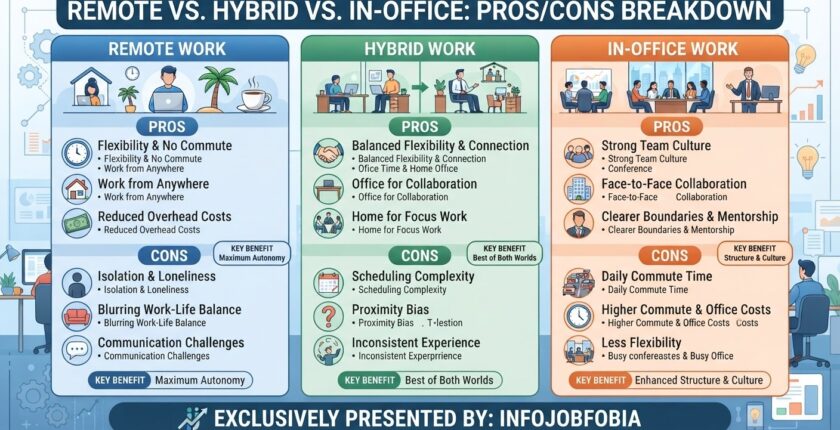
The advantages are clear. Every week you get back hours that used to vanish into transit or traffic. You can better regulate your surroundings, including your chair, lighting, and background noise. For parents and caregivers, it is sometimes simpler to juggle duties. Remote work may really improve concentration and output for those who think best without the ongoing noise of an open workplace.
However, it’s not without cost. Even for devoted introverts, isolation enters more unexpectedly than they imagine. Over Slack, the natural mentoring that takes place when a junior staff member overhears a senior colleague addressing a problem just doesn’t happen the same way. Career visibility can also suffer. It’s an uncomfortable reality that “out of sight, out of mind” still applies in many companies, and remote employees are occasionally overlooked for chances that go to those who are actually there. And without actual organization, the workday might subtly extend into evenings, erasing a line formerly maintained just by exiting the premises.

Naturally self-directed individuals who don’t depend much on impromptu teamwork and whose jobs entail more independent output than continuous real-time cooperation typically find remote work most suitable.
In-Office Work: Connection and Structure at a Price
The traditional approach did not endure this long by chance; rather, it possesses real advantages that were somewhat underrated throughout the remote employment increase. Being there in person facilitates natural cooperation. Quick questions are resolved in thirty seconds instead of languishing in an inbox for a day. Since they are soaking up context just by working alongside seasoned coworkers, new hires scale up more quickly. For better or worse, when employees actually share a building, company culture tends to feel more real.
The advantages include improved relationship-building, quicker problem-solving via brief in-person meetings, clearer separation between work and home life, and usually better exposure for career advancement because face time still affects many promotion choices, regardless of whether anyone admits it freely.
The disadvantages are equally obvious. The daily travel is a real tax on energy and time that accumulates over a year in ways that are simple to underestimate. Especially in open floor plans that make it more difficult to safeguard deep, concentrated work, office settings might be diverting. For those with long travels, health issues, or caregiving duties, a rigid in-office requirement can be a major load independent of their actual job performance.

Early in their careers, people who gain most from mentoring and osmosis-learning, positions needing hands-on equipment or in-person cooperation, and companies where culture and cohesion are central to how the firm runs tend to fit in in-office arrangements.
Hybrid Work: The Middle Ground, With Its Own Difficulties
Hybrid work came as the compromise, and for many businesses and workers, it turned out to be the most sensible option. Some days are set aside for focused, uninterrupted work at home, while other days are set aside for the in-person cooperation and relationship-building that is really more difficult to duplicate remotely.
The advantages include flexibility without complete seclusion, lower commuting expenses than working full-time in the office, and the capacity to arrange your week around when you really need to be among people versus when you need to concentrate.
The disadvantages usually manifest themselves in more understated ways. Coordination becomes a difficulty in itself; if your team isn’t in the office on the same days, you lose much of the collaborative advantage that hybrid is meant to deliver. Office days heavy with meetings could leave little space for the concentrated work you were hoping to safeguard. And contradictory rules among managers or teams can produce a bewildering, unequal experience inside the same organization.

Hybrid works best in companies that are deliberate about it: synchronizing in-office days among teams, reserving focus time on remote days, and being truthful about which types of work truly gain from being in person.
Which One Is Realistically Better, Then?
To be honest, there isn’t a single solution that works for everyone, and anyone who tells you there is hasn’t given it enough thought. Your position, attitude, life events, and the degree of deliberation your firm takes in making whatever model they select actually work well instead of passively falling into it without much thinking all affect the appropriate model.
When you’re looking at a job offer, it’s better to ask specific questions instead of just accepting a general label. For example, how many days does “hybrid” mean here? Is working from home really treated the same in terms of chances for advancement, or does it have a drawback that isn’t immediately obvious? Given whichever model the firm has selected, what does it purposefully do to foster culture and mentoring? The label is less important than how carefully it is actually executed; this is normally where the actual distinction between a pleasant and an irritating work arrangement comes down to.