
The Emergence of Freelancing: Is It Better Than a 9–5 Job?
A decade ago, telling your parents you were resigning to work as a freelancer was essentially code for I don’t have a plan. Today, it’s a real career option that millions of people around the world have chosen deliberately as their first option rather than as a backup. At 11 a.m. on a Tuesday, coffee cafes are brimming with individuals working away on laptops; LinkedIn is brimming with open-to-employment — freelance banners; whole businesses have arisen simply to support this increasing number of independent contractors. The issue that comes naturally then is whether freelancing is genuinely superior to a regular 9-to-5 job or simply a more appealing form of the same fight.
The truthful answer is that it relies on who you ask, what they treasure, and where in life they are. But to properly comprehend the argument, it helps to examine why freelancing has increased so quickly in the first place.
Why Freelancing Became Popular
The development of the gig economy was not coincidental. Several things happened at once. First, because the internet made it possible to deal with clients anywhere in the world, a graphic designer in Lahore can just as readily work for a startup in Toronto as for a company two streets away. Second, tools like Slack, Zoom, Notion, and several project management software made remote collaboration seem practically as easy as working in the same office. And thirdly, maybe most crucially, the pandemic made millions of people reevaluate what employment even entailed. Many people discovered that the commute, the tight hours, and the cubicle culture weren’t really necessary to complete the task when workplaces closed down, and they were unexpectedly working from their kitchen tables.
Furthermore, younger generations started the workforce with somewhat different expectations. Many millennials and Gen Z employees witnessed their parents work for decades with corporate allegiance only to be fired, have stagnating incomes, or experience burnout with nothing to show for it. That encounter reduced the sensation of employment stability from its previous level of confidence. With all its uncertainty, freelancing began to seem less dangerous by comparison, or at least dangerous in a manner that individuals felt they had greater control over.
The Argument for Freelancing
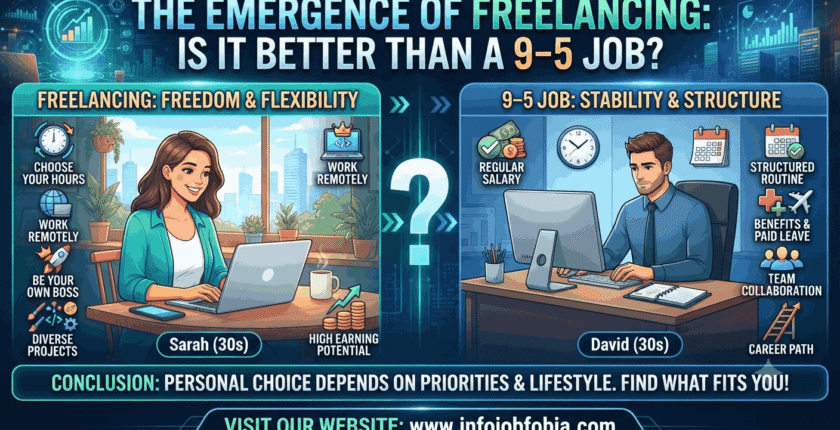
Ask any freelancer what they like most about their job, and “freedom” is usually the first word that comes to mind. The independence to pick their hours, clients, assignments, and usually even their location. One month a freelance writer could operate from a mountaintop cabin; the following month, a beach in Bali. A freelance developer may take any Wednesday off to visit a doctor without requesting permission or completing a form.
Also to take into account is the income cap. In a 9-to-5 job, your income is frequently constrained by your title, the budget of your business, or the going market rate for your position. As a freelancer, your income is tied more directly to your skill, your reputation, and how much work you’re ready to take on. Due to the fact that they are not sharing their worth with an employer who cuts for overhead, some freelancers end up making far more than they ever did in a conventional job.

After that, there is diversity. Working with several clients in various fields keeps things intriguing and enables independent contractors to acquire a far wider range of abilities than someone who has been working the same job at the same firm for years. A freelance marketer is frequently working on Instagram adverts for a bakery in the morning and email campaigns for a tech company in the afternoon. That sort of diversity can be inspiring in a way that repetitive corporate chores seldom are.
Freelancing can really be life-changing for those who have caregiving obligations, medical issues, or just a strong desire for managing their own time. It eliminates the stiffness that makes conventional employment challenging for individuals whose lives don’t exactly fit into a 9-to-5 box.
The Argument for the 9 to 5
However, let’s not act as if freelancing has no drawbacks, because it does. The instability is the most clear disadvantage. One of the most underappreciated amenities a 9-to-5 job offers is a consistent income. You know precisely when and how much money is landing in your account. On the other side, freelancers frequently experience feast-or-famine cycles, which entail a fantastic month followed by a sluggish one in which clients vanish and invoices remain unpaid for weeks.
Another enormous aspect people often undervalue until they lose it is benefits. Health insurance, retirement savings, paid sick days, maternity leave—these are real financial benefits of a conventional job, even if they aren’t shown as a figure on your paycheque. Freelancers have to cover all of these costs on their own, and in nations lacking robust public healthcare systems, this expense can be substantial.

There’s also the emotional aspect of things not discussed enough: loneliness. Conventional employment provides an inherent social framework. You have coworkers, office banter, team lunches, maybe even friendships that last well beyond the work itself. Particularly remote freelancing can be quite isolating. Many freelancers say they yearn for the basic joy of being among other people during the workday once the excitement of no boss, no commute fades.
And then there’s the administrative load. Freelancers are their own accountants, marketers, salespeople, and customer service reps in addition to doing the real work. Chasing late payments, drafting proposals, negotiating rates, and filing taxes as a self-employed person all eat into time that might otherwise be spent working on projects they really enjoy.
Which one is actually better than?
Here is the reality no one actually wants to hear: there is no universal winner. Freelancing is not naturally superior to a 9-to-5, and a 9-to-5 is not inherently better than freelancing. They are simply different trade-offs disguised as a dispute.
If you cherish stability, perks, and a clean line between your professional and personal lives, a conventional job is most likely going to fit you better. If you cherish autonomy, flexibility, and are amenable to some financial uncertainty in return for temporal control, freelancing could be the better option.

Where someone is in their career also matters greatly. A traditional job can provide mentorship, structure, and a consistent environment to develop abilities and a professional network early on, all of which are far more difficult to locate on your own as a freelancer beginning from zero. Once a person has developed knowledge, financial security, and a clientele, freelancing becomes a far more sensible and fulfilling choice later in a career.
There is also a hybrid road that more and more people are quietly selecting: freelancing on the side while working a part-time or full-time job. This best-of-both-worlds strategy enables individuals to explore the freelancing seas, develop a client base, and build a financial safety net before taking a complete dive, if they ever choose to do so at all.
At Last
The growth of freelancing is not simply a transient phenomenon. It symbolizes a real change in perspective on employment, time, and what constitutes a decent job. But becoming more well-known does not necessarily imply that it is the superior option for everyone. For certain individuals in certain circumstances at some stage of life, it is preferable, and for others, detrimental.
The actual issue is not which one is superior but rather which one fits the life I really wish to lead right now. Some see it as the assurance of a regular income and the support of a staff. Others find it to be the independence to create a work life totally on their own terms, which is messy, erratic, sometimes lonely, but ultimately theirs.
And frankly, in a society where employment is becoming increasingly flexible, more people will have the opportunity to determine that for themselves.