
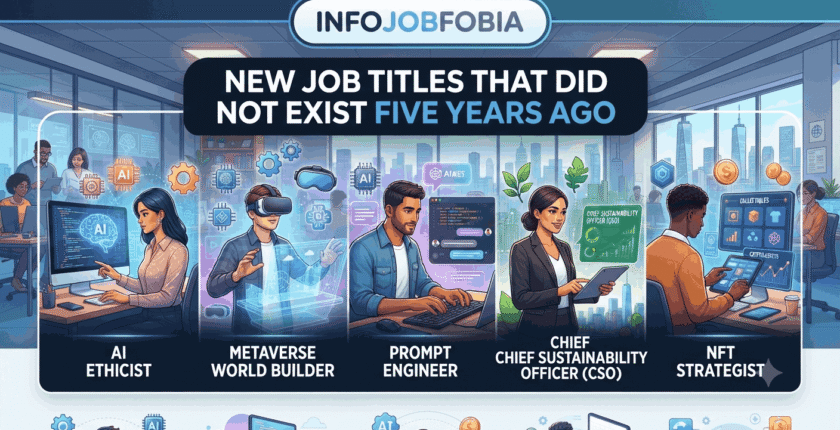
New Job Titles That Did Not Exist Five Years Ago
Five years is not really a long period. It’s about the length of a mortgage refinancing cycle, a few election cycles, or the time it takes a baby to grow into a somewhat autonomous youngster. But in that same brief period, entire job categories have emerged that would have seemed like science fiction to a recruiter in 2021. Few trends have been as startling as the rate at which new job titles are formed, established, and included into popular org charts; we at InfoJobFobia devote much time monitoring changes in the labor market.
This is not just a case of old jobs being renamed for the sake of originality. Many of these positions represent real structural changes in how businesses operate, what they now deem important, and which hazards and possibilities have migrated from the periphery of a company’s focus to its core. We list below some of the most striking new job titles of the last five years, what they actually entail, and why they count for anybody seriously considering their career future.
AI Interaction Specialist and Prompt Engineer
Maybe no title better conveys the pace of current change than prompt engineer. Five years ago, paying someone specifically to create and improve instructions for an AI system would have sounded, at best, like a passing fad. It is nowadays a well-known field inside technology firms, advertising firms, and, more and more, conventional businesses including AI solutions into daily operations.
Designing, testing, and constantly improving the inputs provided to large language models and generative AI systems to generate trustworthy, useful, and safe outputs falls to prompt engineers. As artificial intelligence technologies have become integrated into internal operations, content creation, and customer service, the need for people who really know how to properly interact with these systems has increased in parallel. Related names, like AI interaction designer and conversational AI specialist, have resulted from the same fundamental transformation.
Chief Remote Officer and Hybrid Work Consultant
The change to remote work during the pandemic did not just result in a short-term policy change. It established a whole new field of organizational accountability. Companies with large dispersed workforces came to see that effectively managing remote and hybrid arrangements calls for deliberate strategic focus rather than an afterthought informally handled by HR together with a dozen other duties.

Along with related titles like hybrid work strategist and distributed workforce lead, the chief remote officer is now in charge of creating policies about where and how people work, guaranteeing fair treatment between in-office and remote workers, and maximizing collaboration tools and communication standards across time zones. As businesses rethink how much physical office space they really need, this position sits at the confluence of human resources, operations, and, more and more, real estate policy.
Sustainability and ESG Analyst
Once a niche concern for a small number of values-driven businesses, environmental, social, and governance factors (often shortened to ESG) have become a mainstream need in banking, manufacturing, retail, and other sectors. Investors, regulators, and, progressively, consumers now want businesses to properly evaluate and disclose their social and environmental imprint.
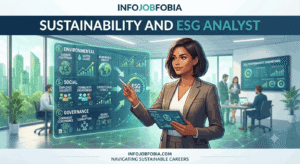
This change has produced a flood of committed sustainability jobs, including ESG analysts, carbon accounting specialists, and sustainability reporting managers. These professionals ensure businesses satisfy progressively sophisticated regulatory disclosure criteria by tracking emissions data and assessing supply chain policies. In many businesses, what was formerly a small compliance role buried within a larger department has evolved into its own specialized team with a direct route to senior management.
Head of Employee Experience Working from Home
Closely linked to the growth of distributed work but different in emphasis is the appearance of positions solely focused on remote employee experience. While traditional employee experience jobs centered on office benefits, physical workspace design, and in-person culture-building, this new title concentrates on duplicating and reinventing that feeling of connection and belonging for a workforce that might never share a physical location together.

Designing virtual onboarding experiences, creating asynchronous communication norms that consider several time zones, and discovering meaningful methods to foster culture and appreciation free from shared physical presence are usually part of this role. It represents a greater understanding that remote work, when done effectively, necessitates intentional planning rather than just transferring in-office techniques onto video calls.
Data Privacy and Artificial Intelligence Ethics Officer
The ethical and legal concerns surrounding both have gotten significantly more complicated as data collection has become more advanced and artificial intelligence tools have taken on more decision-making power inside corporations. This has led to specialized positions that are solely centered on negotiating that complexity.
AI ethics and data privacy officers are in charge of making sure that a company’s usage of personal data and automated decision-making systems is in line with an increasingly complex patchwork of rules while also taking into account the larger ethical consequences of how these technologies are used. This position requires a really exceptional mix of abilities that did not often overlap in one employment description until very recently since it spans legal, technical, and communications domains.
Virtual Experience and Metaverse Designer
Although the general enthusiasm surrounding the metaverse has subsided somewhat since its heyday, the fundamental knowledge it produced has found long-lasting, useful utility. Building immersive digital worlds for uses ranging from virtual product displays to remote onboarding simulations, virtual experience designers today operate across gaming, retail, real estate, and business training.
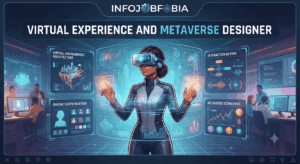
This position combines aspects of conventional graphic design, user experience design, and game development, used to create environments that did not really exist as commercial settings five years ago. Particularly, businesses in retail and real estate have discovered real worth in letting consumers tour products or properties virtually before buying something.
Algorithm Bias Investigator
A specific role has developed to investigate if automated systems are operating equitably as they become more influential in hiring decisions, loan approvals, insurance pricing, and numerous other significant results. Working with data science and legal teams to spot and fix issues before they cause actual harm or regulatory exposure, algorithm bias auditors assess automated decision-making systems for unintentional discriminatory patterns.

This position shows a growing awareness that automated systems are not naturally neutral just because they are automated. They mirror the data and assumptions integrated into them, and progressively businesses are realizing the need for specialized supervision to guarantee these systems meet the same fairness criteria as human decision-makers.
What This Means for Your Career
Almost all of these new titles share the common thread that they combine two or more previously distinct disciplines: technology and ethics, human resources and remote infrastructure, sustainability and finance, design and virtual environments. Professionals who can easily navigate these intersections rather than limiting themselves to a single classic field are more and more obtaining these recently established positions.

For job seekers looking through InfoJobFobia or any other employment resource, there is a practical lesson here: the job titles that will count in the following five years are not likely to resemble precisely the ones that rule the listings now. The most reliable approach to get yourself ready for what comes next is to remain truly inquisitive, develop related abilities outside your primary field, and observe where industries are converging rather than comfortably remaining within acquainted confines. Rarely are the experts who flourish in times of rapid change the ones who precisely foresaw the new job title that would surface. They constructed a large enough basis to rapidly adjust when it did.