
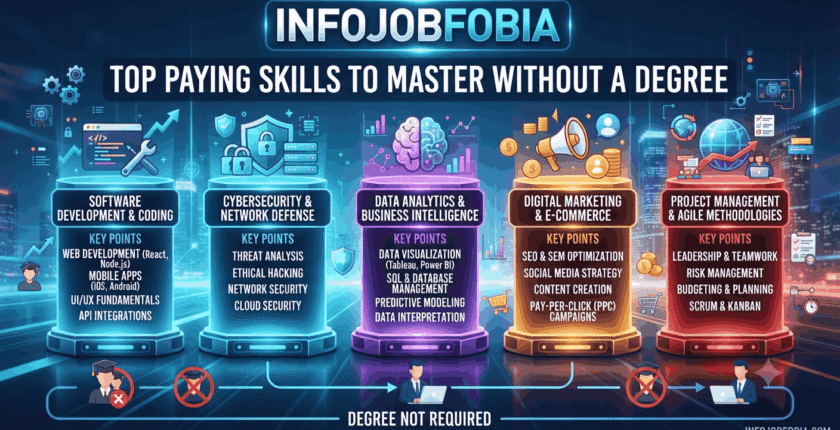
Top Paying Skills to Master Without a Degree
The message was straightforward for years: earn a degree and land a decent job. But you’ve probably observed that message hasn’t held up as well if you have been following the employment market over the last several years. Tuition continues to rise, graduates continue to battle for jobs in their profession, and at the same time an increasing number of individuals with no college experience are making six-figure wages. That isn’t a coincidence; it’s a real change in how companies recruit and how skills are appreciated.
We speak with job applicants every day at infojobfobia who believe that the only path to a high-paying job is through a degree. It is not. Employers value more what you can really do than what is written on a diploma. In truth, recent employment figures indicate that around 5.7 million full-time employees in the U.S. without a bachelor’s degree already earn $100,000 or more per year. Their unique, high-value talents they decided to develop set them apart from others, not chance.
Therefore, what are the highest-paying talents right now, and how practical is it to acquire them without the conventional college education? Let’s go step by step.
Why Talents Are Outnumbering Degrees
Several factors are working concurrently to cause this change. Companies are facing a shortage of skilled workers in key areas, especially in tech and security, where the number of available workers has not increased at the same rate as demand. Certifications and portfolios have become much more trustworthy evidence of ability than they once were. Employers, particularly fast-moving ones, would choose to hire someone who can demonstrate they are capable of performing the work now rather than wait for a candidate to complete four more years of education.
This is not to suggest that official education is worthless; it is obviously still important in disciplines like law or medicine. But for a large portion of the highest-paying jobs available today, the actual need is not a degree. It might be a license, a certification, a portfolio that has been shown, or an apprenticeship. According to one current business analysis, high-income skills are practical abilities that companies pay a premium for as they raise income, security, efficiency, decision-making, or leadership; and increasingly, none of this calls for a university stamp of approval.
Machine Learning and AI Engineering
This one is the one skill that rules the discussion in 2026. With a median U.S. base pay between $150,000 and $200,000, AI engineering is currently the highest-paid skill on the market. For a field that is still relatively new, that is an amazing figure that shows just how badly businesses want people who can construct, refine, and implement AI systems.

The good news is that this is not a field that is restricted to individuals with a computer science degree. Many self-taught engineers have developed their careers by working on open-source projects, taking hands-on classes, and helping to create actual AI tools. Although it requires a lot of technical discipline, the earning potential here is probably the greatest of any talent on this list.
Cybersecurity
Quietly, cybersecurity has developed into one of the most reliable, best-paying disciplines available to persons without a degree, and the statistics support this. Around 3.5 million cybersecurity positions worldwide are currently vacant, a shortage that has persisted for more than ten years. This means that skilled applicants encounter much less competition than in the majority of other fields.

Especially motivating is the fact that companies in this field really give evidence of ability above academic experience. Simply stated, according to one source, “many employers care far more about certifications like CompTIA Security+, CEH, or CISSP than diplomas”. Provided they continue collecting certifications and practical experience, someone starting from a security analyst job can realistically advance to a security management position earning well into six figures in a few years.
Web and Software Development
For those without a degree, coding continues to be among the most reliable high-income abilities, primarily because the field has always placed greater importance on functional code than on scholastic qualifications. Here, bootcamps, self-taught courses, and open-source contributions can all result in actual opportunity, but there is a catch. Software development may be entered without a degree, but typically more portfolio depth is required to make up for the absence of a formal qualification. Simply said, you will have to strive a little harder to establish yourself, but the door is really open.

With hiring usually depending much on your portfolio, web development in particular tends to be one of the quicker entry routes into technology, as a concentrated bootcamp or self-taught course might take months rather than years.
Skilled Trades (Electrical, HVAC, and Elevator Works)
When discussing high-income occupations, it’s easy to forget the trades, but the figures reveal another tale. For instance, one of the best-kept secrets in the no-degree employment market is the installation of elevators and escalators. This trade pays six figures at the top end, trains people through paid apprenticeships, and is difficult to automate or offshore, which keeps both demand and pay strong.

Especially as severe weather drives demand for heating and cooling equipment around the country, HVAC is another trustworthy choice. HVAC technicians usually make between $50,000 and $60,000, while overtime in many markets drives that closer to $90,000. Usually necessitating an apprenticeship rather than a degree, these positions have a far lower entry hurdle than people imagine.
Custom Welding
Although welding is rejected as a blue-collar trade, specialized welding reveals a quite different narrative. Regular welding doesn’t pay much, but the specialized branches change the picture completely. With AWS certification and specialist training, underwater welders, pipeline welders, and structural welders can earn six figures. Underwater welding is particularly a combination of commercial diving and welding knowledge, and among the most physically demanding and best-paid professions available today.

Careers in aviation (air traffic control and commercial piloting)
Aviation is one of those sectors where the pay is good, the training is rigorous, and a degree is not the most important thing. For example, commercial pilots do not require a bachelor’s degree at all; while major airlines often prefer degrees, commercial pilots flying cargo, charter flights, crop dusters, or tours can build a career without one. Air traffic control follows a similar pattern, requiring intensive training and certification rather than a university education, and it remains among the higher-paying no-degree occupations on offer.

SEO and Digital Marketing
Not every well-paid competence entails technical equipment or life-or-death situations. For those ready to learn on their own, digital marketing, particularly SEO, has become a real road to a high income. This is one of the most reachable starting points on this list since much of this field may be learned independently by means of actual projects, case studies, and quantifiable outcomes. Once they prove a history of helping companies achieve actual growth, specialists in this field can advance fairly quickly from entry-level positions to strategic or director-level ones.

Real estate and high-commission sales
Regardless of degree, real estate is still one of the most unrestrained income possibilities available anywhere. Here, licensing, negotiation ability, and tenacity matter much more than official education. The best performers in major markets, especially those dealing with luxury or business real estate, can earn much more than what most jobs requiring degrees provide. The trade-off is that income is not guaranteed the way a salary is; it is based totally on performance, which is not for everyone but rewards individuals ready to put in the effort.

Renewable Installation and Solar Energy
This industry has quietly emerged as one of the fastest-growing no-degree careers as renewable energy investment continues to rise. The median income for solar installers is $57,230, and these are among the fastest-growing jobs in the nation. Moving into sales or project management positions inside the sector can significantly raise this number. Since entry normally calls for short-term technical training as opposed to years of education, it is among the more accessible choices for someone beginning from zero.

Nuclear and Specialised Technical Positions
Nuclear technician jobs and other specialized technical jobs in the energy and infrastructure sectors pay very well and do not require a bachelor’s degree; they are somewhat under the radar. Although these positions usually require demanding, safety-critical training, this same complexity keeps pay high and competition fairly low. Though not the most often discussed occupations, they are among the most financially rewarding courses for someone ready to specialize.

The Common Thread
Looking through all of these abilities reveals an obvious trend. The top-paying, no-degree jobs often involve hands-on work, licenses, or significant technical expertise. Importantly, they are also showing greater resilience against the threat of AI disruption compared to many white-collar, degree-required desk jobs. As one recent study noted, the highest pay without a four-year degree tends to concentrate in licensed, physical, equipment-driven, or patient-facing work, and those same traits tend to be more resilient to current AI than text-heavy desk jobs.

Anyone evaluating their choices today would find that especially valuable. It’s not just about what pays well right now; it’s also about what’s likely to still be valuable five or ten years from now.
How to Realistically Begin
It’s only half the equation to know which skills pay well. The other half is choosing one and seeing it through. If you’re serious about this road, here are a few realistic pointers:
Choose one ability and devote yourself. Depth triumphs breadth here, even if it’s alluring to dabble in many spheres at once. Employers look for actual ability, not a jumbled inventory of courses that are only partially completed.

Discover the precise path of credentials. Find out exactly what gatekeepers in that field expect to see, whether it is a certification, a license, an apprenticeship, or a portfolio, and work toward it deliberately.
Speak with those who are currently working. Nothing beats getting firsthand information from someone who is really working in the field you are aiming for. They will inform you far more quickly what really counts than any essay could.
Make evidence, not simply knowledge. Employers require something tangible to assess, whether it’s a portfolio of work, recorded apprenticeship hours, or a finished certification test. The first step is learning the skill; proving it is what actually leads to employment.
At last
The notion that the only way to get a decent income is via a degree is rapidly becoming obsolete. There are more valid, high-paying paths into a successful career than ever before, whether it’s developing AI systems, defending networks from cyberattacks, installing solar panels, or mastering a skilled trade, and none of them demand four years and a mountain of student debt.

The actual issue is not whether these possibilities are there. Obviously. The issue is which one best matches your interests, talents, and the type of work you really want to be doing five years from now. Choose that one, dedicate yourself totally to it, and income usually follows.