
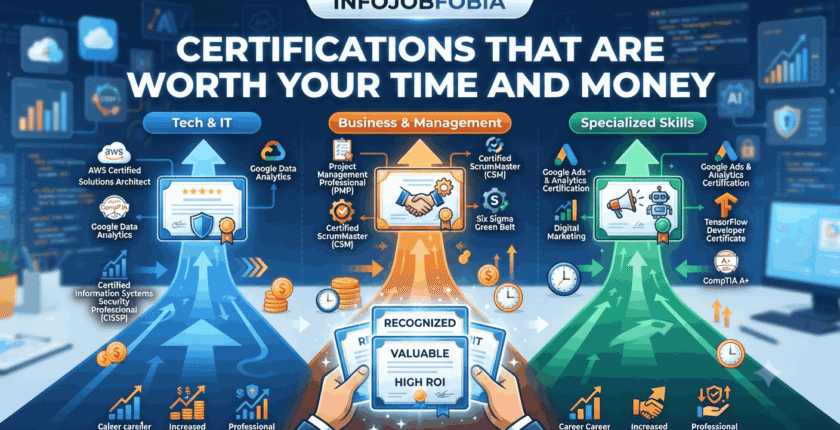
Certifications Worth Your Time and Money
If you’ve looked at job listings in the past five minutes, you’ve probably noticed that certifications are everywhere. Google Certificates, PMP, AWS, Six Sigma, HubSpot, Scrum — the list seems never-ending, and the marketing surrounding them does as well. Every course website wants to persuade you that their badge will instantly advance your career.
However, this is the reality. Some credentials really create opportunities. Others are basically just a line on your resume that nobody checks, and nobody cares about. Distinguishing the two before you use your money—and your evenings—on one is the difficult part.
Let’s be honest about which certifications are really worthwhile, how to decide if one is ideal for you, and how to keep clear of squandering time on something that seems fantastic but advances your profession not at all.
Why Certifications Count (When They’re the Appropriate Ones)
Employers hire people able to handle problems. A certification, at its best, is evidence that you can do precisely that—it’s a shortcut that tells a hiring manager this individual already knows how to do X without having to take your word for it.
Not all certifications have that weight, though, and that’s the issue. Some are truly admired and industry-wide known. Others are made by businesses primarily to increase course sales, and hiring managers hardly pay attention to them.
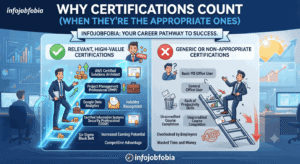
Ask yourself three questions before you sign up for anything:
Is this certification accepted by companies in my sector, or just by the platform selling it?
Does it teach me a skill I can really show instead of simply a badge I can flaunt?
Am I doing it because it sounds nice, or will it advance me toward a certain employment or raise?
You are ahead of most individuals selecting certifications at random from a list if you can respond to them precisely.
Certifications Worth Thinking About (By Industry)
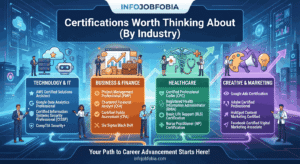
For IT and Tech Employment
Early in your career in particular, technology is among the few fields in which certifications may really stand in for a degree.
AWS Certified Solutions Architect and other AWS certifications are highly valued since cloud computing knowledge is in great demand and businesses are actively having difficulty locating qualified individuals. The same applies to Google Cloud and Microsoft Azure certifications; select based on the cloud provider that is most prevalent in your desired field.

If you’re entering IT support or cybersecurity with no prior experience, CompTIA A+, Network+, and Security+ are excellent starting points. They are commonly accepted, somewhat priced, and employers know precisely what they mean.
If you’re serious about a cybersecurity career, Certified Information Systems Security Professional (CISSP) is the gold standard, though you do need work experience before you can obtain it—thus, it’s more of a mid-career move than a starting point.
Regarding Project Management
Offered by the Project Management Institute, Project Management Professional (PMP) is among the most reputable certificates in all industries, not only in technology. It indicates that you have the ability to plan, implement, and deliver projects on time and within budget, which is a talent in demand in every field.
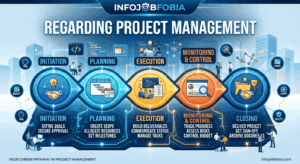
If PMP seems like too large of a step, CAPM (Certified Associate in Project Management) is a respectable entry-level substitute, and Scrum Master certifications (like CSM or PSM) are worthwhile if you want a position in an agile team setting, which is becoming more prevalent even outside of tech.
For Digital and Marketing Capabilities
Marketing is a field where free and low-cost certifications can honestly help, primarily because the tools change so rapidly that employers want evidence you are familiar with the current platforms.
Free, reputable, and directly related to the abilities organizations use daily are Google Analytics and Google Ads certifications. HubSpot Academy provides a range of free certifications in inbound marketing, content marketing, and email marketing that are highly regarded, especially for entry-level positions or freelancers looking to build a portfolio.
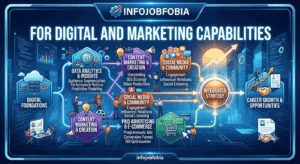
If you’re going for a more strategic position, Meta’s Digital Marketing Certificate and certifications in SEO tools like SEMrush or Ahrefs can also add credibility.
For Accounting and Finance
This is a field where certifications are usually prerequisites rather than discretionary extras. If you are serious about a career in accounting, then a CPA (Certified Public Accountant) is still absolutely vital. Although it’s a significant time commitment spanning several test levels, CFA (Chartered Financial Analyst) is the industry norm for investment and finance occupations.
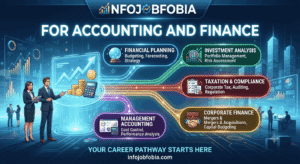
For something faster and still valuable, Certified Financial Planner (CFP) or Financial Modeling & Valuation Analyst (FMVA) certifications are increasingly recognized, particularly for roles in corporate finance and financial planning.
For Human Resources
Both PHR (Professional in Human Resources) and SHRM-CP (Society for Human Resource Management Certified Professional) are highly regarded in the HR world and might assist you in transitioning from generalist HR work into more specialized or senior positions.

For Data and Analytics
One of the fastest-growing areas of demand is data skills, and certificates in this field usually pay off immediately. For newbies, a wonderful, reasonably priced starting point is the Google Data Analytics Certificate. Certifications in SQL, Python for Data Analysis, and Microsoft Power BI are genuinely important for more advanced jobs as they directly correspond to tools that businesses use on a daily basis.

For Process and Quality Improvement
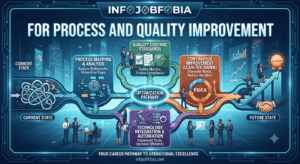
Six Sigma credentials (Green Belt and Black Belt) are quite helpful in operations, logistics, healthcare, and manufacturing jobs. They demonstrate your grasp of waste reduction and process improvement, a talent applicable in practically any sector having physical or operational workflows.
Certifications Possibly Not Worth It
Not every badge warrants your funds. Be wary of:
- Certifications from unapproved or unknown platforms that do not appear in searches are not respected. If no one is discussing them online, companies most likely have not heard of them either.
- If you can pass the exam simply by memorizing multiple-choice responses with no actual project or show of ability, certifications without a practical component most certainly won’t wow anyone.
- Anything absurdly pricey with no discernible return on investment (ROI): before shelling out a significant amount, peruse job ads in your desired field and find out how often that particular accreditation is genuinely listed as a requirement or choice.
How to Pick the One That Is Best for You
Work backward from your objective rather than choosing a certification because it is popular:

- See job ads for the position you desire. Which qualifications keep appearing? That’s your brief list.
- Determine whether it’s a single-company badge or an industry-wide standard. Standards such as PMP or CPA have weight everywhere. Badges exclusive to companies are less common.
- Think about the expense against the possible profit. Comparing a $50 Google certificate that helps you get a job to a $2,000 course that doesn’t impress anyone, the Google certificate is the better option.
- Consider your timeline. Some certifications need a year of study and several examinations, while others only need a weekend. Connect your decision to your present life circumstances, not only your ambition.
Last Reflections
Certifications aren’t mystical. On their own, they will not replace experience and certainly won’t remedy a poor resume or a terrible interview showing. However, the appropriate certification, purposefully chosen and linked to a definite purpose, may unquestionably have a real impact, helping you get beyond resume filters, feel more assured in interviews, and acquire skills you will really utilize.
Being choosy is essential. Do not gather certifications as if they were honors. Choose one or two that truly fit where you want to go, then put in the effort to actually learn the content (not just pass the exam). Let your concentrated work speak for itself.

Your resources are limited by time and money. Spend them on certificates that actually create opportunities, not those that just appear nice on a resume that no one reads twice.