
Recruitment and company culture are both being changed by artificial intelligence.
AI in the office only meant a spam filter working quietly in the background or a chatbot responding to IT inquiries not too long ago. That incarnation of artificial intelligence was simple to disregard. The current edition is not. Quietly rewriting what a typical workday even looks like, it’s influencing team interaction and sitting in on hiring decisions. Though either way, it’s vital to know what is actually changing and what isn’t, depending on your position in the company.

Recruiting was the first domino to fall.
Hiring has always been an odd blend of data and intuition; hence first place AI tools discovered actual use. Though it has been years since resume screening tools came out, what is currently happening goes much beyond simple keyword matching. Modern hiring tools can evaluate applicants depending on skills gathered from project background, highlight probable cultural fits depending on communication samples, and even project how long someone is probably to remain in a position based on trends from thousands of past hires.
Recruiters are not rejecting fewer applications because they became lazy; rather, technology already weeded off the ones that obviously don’t fit the position. In theory, that means recruiters focus their scarce time on candidates who really have a shot instead of poring over hundreds of applications that never got anywhere.

To mimic actual job settings before a candidate is ever hired, some businesses have gone even farther by using augmented and virtual interfaces during technical interviews or onboarding sessions. Though it sounds futuristic, it is in fact for a common cause: cut the uncertainty of whether this individual will really be competent at this work.
The Upside Nobody Talks About Enough
This discussion may also center just on job losses; therefore, the concern is understandable. However, recruiting’s really helpful but underappreciated aspect is artificial intelligence. If done well, it can help to eliminate some types of bias—a meticulously reviewed resume screener won’t grow exhausted at 4 p.m. and start reading, and it won’t unintentionally favor a name that sounds familiar.
Additionally, helping smaller businesses to compete with big ones for talent is artificial intelligence. A five-person startup may now access the same caliber of applicant tracking complexity that was formerly only available to businesses with committed recruiting departments. That is a significant change in not only who is recruited but also who has meaningful access to excellent recruiting tools.
Where It Gets Complex
None of this comes without actual trade-offs. Algorithms developed on historical hiring data may reproduce the exact prejudices they were meant to eradicate—only less overt and more difficult to contest in form. At least one person you can challenge: a biased human recruiter is at least one person. An unfair algorithm making choices across thousands of applications is a far greater issue behind a far narrower discussion.
The components of hiring that used to feel private also have a very human expense. Candidates more and more say they are presenting for a system rather than speaking to a person—optimising their CV for reading by a machine instead of for a human reader. Though efficiency increases, something is lost there.
Work culture is changing too—not just recruiting.
Once a person accepts the position, the changes never stop. Artificial intelligence is changing daily workplace practices in ways that are simple to overlook since they unfold slowly. Automatic transcription and summarization of meetings follow. Project management solutions spot bottlenecks before a manager would ever manually spot one. In some companies, even performance evaluations now draw on current project data instead of depending only on a manager’s memory of the previous six months.

This change toward ongoing, data-driven feedback has actually altered some teams’ operations. Employees at AI-forward businesses now often receive more frequent, less detailed feedback about their performance rather than waiting for an annual evaluation. People who grow on ongoing comments will benefit much from this. For others, it may seem a bit too close, as if they are being observed.
The New Standard Is Human-Machine Collaboration
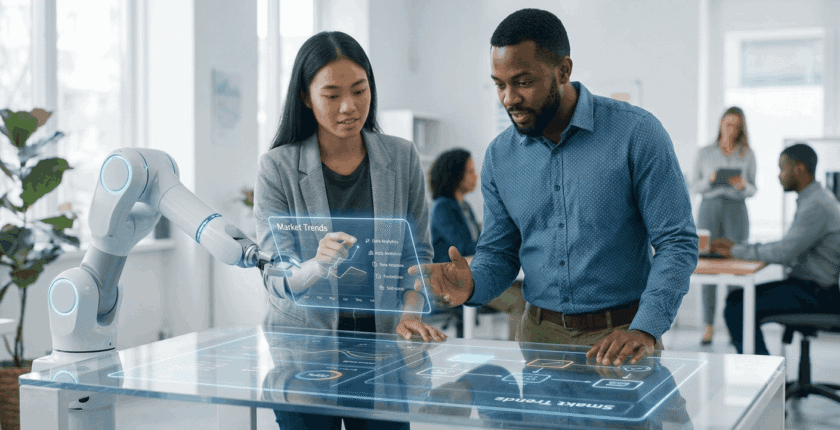
The way teams really work day to day may be the most noticeable change. Employees are increasingly working next to robots and artificial intelligence technologies not as a substitute for their judgment but rather as an extension of it—reviewing AI-generated market analysis jointly, cross-checking a recommendation before making a final call, or letting a tool handle the repetitive first draft of a report so people can focus on interpretation and strategy.

Rather than a simple replacement approach, most sectors seem to be actually headed toward that cooperation model—at least for now. The jobs that are vanishing typically revolve around repetitive, repeatable chores. Growing jobs are often those that need precisely what artificial intelligence still struggles with: judgment, empathy, and the capacity to decide when the data is incomplete or inconsistent.
This is What It Means for Employees and Job Aspirants
One useful lesson from all of this is that instead of a specialized talent, fluency with artificial intelligence applications is fast becoming a basic requirement. Though you don’t need to be a data scientist, knowing how to interact with these tools and when to trust and question them is becoming as fundamental a corporate talent as knowing how to send an email or conduct a meeting.

Those who are doing this correctly are not pursuing artificial intelligence for its own sake. They are the ones thinking about which decisions ought to remain human, which processes really gain from automation, and how to maintain the environment where people truly want to be even as the tools surrounding them keep evolving.